Did some much needed maintenance today. I did a fair-sized water change of 40 gallons. Rather than just swapping out water, however, I decided to siphon out the detritus from sand bed, using that water as my exchange water. I removed so much detritus, I'm surprised my tank hadn't crashed before. I didn't take a Nitrate reading beforehand, however, I'm sure it's much lower now.
As well, the salinity in the tank was at 1.016, which is really low considering the optimal salinity is 1.024. Doing the big water change helped increase the salinity. Afterwards, it rose to 1.018. This is a good start, as it needs to climb gradually to 1.024. This can be achieved by topping off my water with saltwater, rather than purified water.
Monday, September 9, 2013

Saturday, September 7, 2013
New Fish - Potter's Angelfish and Bicolor Blenny
A Potter's Angelfish was added to the community. It's about 2.5" in size and seems to be fairly healthy, as its quite active. Initially, it was being harassed by the Purple Tang and the Goldbar Maroon Clownfish, however, they've seemed to get over it quickly as they don't seem to bother with him anymore.


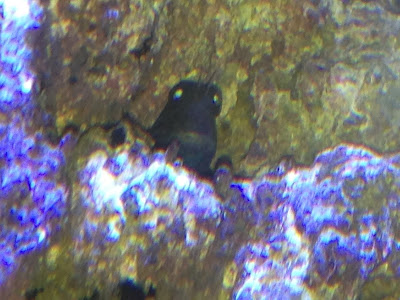
As well, a Bicolor Blenny was added to the community. He's not as busy as the Potter's Angelfish, however, he has lot's of personality and spends his time perching on the rock. He's still a bit shy, but here he is:
Potter's Angelfish

Potter's Angelfish and Gold Bar Maroon Clownfish

Potter's Angelfish with Yellow and Purple Tangs

As well, a Bicolor Blenny was added to the community. He's not as busy as the Potter's Angelfish, however, he has lot's of personality and spends his time perching on the rock. He's still a bit shy, but here he is:
Bicolor Blenny - Playing Peek-A-Boo

Sunday, September 1, 2013
Ecotech Radion LED Lights
The existing Metal Halide / VHO lighting will be replaced with Ecotech Radion LED lighting. There are countless benefits to switching to these lights:

- The lighting will be aesthetically better.
- Power consumption will decrease dramatically.
- No more purchasing new metal halide and VHO bulbs every year.
- No need for moonlights.
- Lighting is completely programable.
- Remote access to the light configuration.
- Works in tandem with Ecotech MP40w ES pumps.
- Easier integration with Profilux system controller.
- Ecotech provides optional power backup system.
I purchased three Ecotech Radion lights about a year ago.

However, I hadn't gotten around into deciding how to implement them into the system, until now. My plan is to create another aluminum rack and hang the lights from the rack. The lights will hang from the rack using support beams, which can slide horizontally across the rack. This allows me the option to place the lights wherever I want across the tank. Regarding the distance of the lights to the surface of the water, there is no longer a need for manually changing it. If you want more light, rather than bringing the lights closer to the surface, all that is needed is to increase the intensity of the lights. The Ecotech Radion lights are so powerful that running them at full power is too much for corals to handle anyways. Hanging them ten inches from the surface is optimal, which is where I have them placed.
The aluminum rack is smaller, at five feet, than the previous one built for my metal halide / VHO setup, at a little over six feet. It will have a smaller foot print and give more space within the canopy. Here are the lights implemented into the system. Much cleaner than the previous MH / VHO setup.


Saturday, August 31, 2013
Revitalization of Regala's Reef
It's been a little over nine months since my last post, as well as any substantial changes to the system. During that time, I've just been maintaining the tank. It's unfortunate when life get's in the way of our hobbies. Changing careers tends to shift one's priorities. Nonetheless, recent changes have allowed me to switch my focus back to reefkeeping. I must admit, it's quite refreshing to come back to the hobby after a hiatus.
Perhaps the only recent change is with the bio pellets. In my previous post, I had reintroduced bio pellets into the system, however, the Maxijet 1200 pump just wasn't sufficient enough to keep the pellets tumbling, at least not the amount of bio pellets that I need to use, and would periodically clog up. Therefore, I removed it from the system until I find a better implementation.
For some time now, I've had some plans for the system and I plan to pick away at the list until I've implemented them:
Perhaps the only recent change is with the bio pellets. In my previous post, I had reintroduced bio pellets into the system, however, the Maxijet 1200 pump just wasn't sufficient enough to keep the pellets tumbling, at least not the amount of bio pellets that I need to use, and would periodically clog up. Therefore, I removed it from the system until I find a better implementation.
For some time now, I've had some plans for the system and I plan to pick away at the list until I've implemented them:
- Replace the metal halide lighting with LEDs, specifically, with Ecotech Radion lights.
- Replace the Tunze pumps, specically, with Ecotech MP40w ES pumps.
- Reintroduce bio pellets with a better implementation into the system.
- Create new structures with Marco rock and introduce new aquascape into the system.
- Once the system's parameters are optimal, begin reestablishing an SPS dominant reef.
- Complete the system's enclosure.
- Implement an auto top-off unit with a better water reserve.
- Install a UV filter.
(I will link each item in the list to a separate post, during its progress.)
I look forward to working on the system and getting it to a state that I can be proud of.
Wednesday, November 28, 2012
Bio Pellets - Round 2
After a few months hiatus, I've decided to try out bio pellets again. I previously switched from the bio pellets to Fauna Marin, as the pellets did too good of a job stripping my water of nutrients. However, I found the Fauna Marin to be too much maintenance for my liking, not to mention the added cost.
So why would I switch back to bio pellets after the disastrous results of my initial trial? Well, the bio pellets did exactly what they were intended for... to clean the water, it just did too good of a job by stripping all the nutrients. I knew something was missing so I did some research and it turns out that in order to run bio pellets successfully, you must find that fine balance of the right amount of bio pellets to use in accordance with your system. In hindsight, I probably used too much in my initial trial, which is why my water was completely stripped of nutrients.

This time, I am using NPX Bioplastics bio pellets. Based on the recommendations on the packaging, I am to use 100 ml per 25 gallons. With my system being 135 gallons with a 55 gallon sump and subtracting the volume taken up by the live rock, I would estimate that I have roughly 150 gallons. This would mean that I need to use 600 ml of bio pellets. There is also a warning on the packaging about starting off with half the recommended dosage to prevent algae blooms, so I did just that. I set up 300 ml of bio pellets in the reactor, and will gradually add 100 ml at a time to reach 600 ml, all the while testing the system to ensure I'm not using too much.
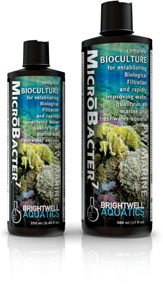
 In my research, I also came across another key point. Because bio pellets are only a carbon source, its important to seed with a good bioculture, and that most have been successful using Brightwell's Microbacter7. I did not do this in my initial trial, which probably would've made a significant difference. I will be supplementing the bio pellets with it this time around.
I'll monitor and tweak the system in the coming weeks and hopefully provide some positive updates.
So why would I switch back to bio pellets after the disastrous results of my initial trial? Well, the bio pellets did exactly what they were intended for... to clean the water, it just did too good of a job by stripping all the nutrients. I knew something was missing so I did some research and it turns out that in order to run bio pellets successfully, you must find that fine balance of the right amount of bio pellets to use in accordance with your system. In hindsight, I probably used too much in my initial trial, which is why my water was completely stripped of nutrients.

This time, I am using NPX Bioplastics bio pellets. Based on the recommendations on the packaging, I am to use 100 ml per 25 gallons. With my system being 135 gallons with a 55 gallon sump and subtracting the volume taken up by the live rock, I would estimate that I have roughly 150 gallons. This would mean that I need to use 600 ml of bio pellets. There is also a warning on the packaging about starting off with half the recommended dosage to prevent algae blooms, so I did just that. I set up 300 ml of bio pellets in the reactor, and will gradually add 100 ml at a time to reach 600 ml, all the while testing the system to ensure I'm not using too much.
I'll monitor and tweak the system in the coming weeks and hopefully provide some positive updates.
I'm Back!
It's been a while since I've posted on Regala's Reef so I thought I'd give an update.
Life has become quite busy for me, due to a career change, but couldn't be happier, career-wise. Unfortunately, this left me with little time to devote to the tank, aside from the regular husbandry duties of maintaining it. As of lately, my schedule is starting to settle and am finding myself devoting more and more time to the tank. I've started a few projects, which I will go into greater detail in their own posts, but here's an overview:
Stay tuned for updates on these upcoming projects. It's great to be back!
Life has become quite busy for me, due to a career change, but couldn't be happier, career-wise. Unfortunately, this left me with little time to devote to the tank, aside from the regular husbandry duties of maintaining it. As of lately, my schedule is starting to settle and am finding myself devoting more and more time to the tank. I've started a few projects, which I will go into greater detail in their own posts, but here's an overview:
- New LEDs (Ecotech Radions)
- Exterior Build for the Frame
- Bio Pellets - Round Two!
Stay tuned for updates on these upcoming projects. It's great to be back!
Sunday, December 11, 2011
Fauna Marin Ultralith System
It's been a few weeks since the last update and there's been quite a few changes to the system.
A few months back, I began using Bio Pellets to improve the water quality in the tank, which in turn, would improve the coloration of the corals, specifically my SPS corals. The first few weeks went very well and the quality of the water improved dramatically, the coral colorations became vibrant, and they showed excellent polyp extensions. However, the next few weeks to follow were disastrous. I began to lose colonies of corals, one by one, as they would begin to STN (Slow Tissue Necrosis). I constantly monitored my water parameters, however, none were out of sort. I was frustrated, to say the least. A few weeks went by and I pretty much lost all my SPS colonies, however, the other corals (LPS, etc...) were doing well. I finally figured out the issue. The Bio Pellets did a phenomenal job cleaning up the water... in fact, too well. They had completely stripped my water of all nutrients that my SPS needed and they basically starved to death.
I've spent the next few weeks trying to get my tank back on track, which is why I haven't posted lately, as I was busy. Needless to say, I removed the Bio Pellet reactor from the system. Normally, I would just let the system bounce back on its own, slowly acquiring nutrients back from numerous feedings, fish detritus, etc... However, I don't have that option because I need to run a ULNS (Ultra Low Nutrient System) due to my heavy bio load of large tangs. I've done quite a bit of research and have decided to run the Fauna Marin Ultralith System.

Basically, the Ultralith System utilizes special "rocks" called Zeolite Filter Media and a combination of additives. The Zeolite are extremely porous rocks that, when viewed under a microscope, look like sponges. The additives are combination of carefully selected beneficial bacteria that will inhabit these rocks and eat the excess nutrients from the water, thereby purifying the water. Other additives are also used which replace the stripped nutrients, with better nutrients to feed the corals. In essence, the water is purified and the amount of beneficial nutrients are "controlled". The addition of the Zeolite rocks themselves is synonymous to adding a thousand pounds of live rock to your system. I acquired a new reactor for the Zeolite rocks (Vertex Zeovit Reactor ZF-30), which has been added to the system. It's the first week on the Fauna Marin Ultralith System and I will report its progress.

On a side note, there was another issue with the tank. I had recently added an RBTA (Red Bubble Tip Anemone) to the tank. Unfortunately, my GBTA (Green Bubble Tip Anemone) had began to move and encountered the RBTA. They began to "fight" using chemical warfare and resulted in the death of both of them, as well as all the surrounding frilly mushrooms. They were all removed. Once the tank is back in pristine shape, I will add another RBTA.
A few months back, I began using Bio Pellets to improve the water quality in the tank, which in turn, would improve the coloration of the corals, specifically my SPS corals. The first few weeks went very well and the quality of the water improved dramatically, the coral colorations became vibrant, and they showed excellent polyp extensions. However, the next few weeks to follow were disastrous. I began to lose colonies of corals, one by one, as they would begin to STN (Slow Tissue Necrosis). I constantly monitored my water parameters, however, none were out of sort. I was frustrated, to say the least. A few weeks went by and I pretty much lost all my SPS colonies, however, the other corals (LPS, etc...) were doing well. I finally figured out the issue. The Bio Pellets did a phenomenal job cleaning up the water... in fact, too well. They had completely stripped my water of all nutrients that my SPS needed and they basically starved to death.
I've spent the next few weeks trying to get my tank back on track, which is why I haven't posted lately, as I was busy. Needless to say, I removed the Bio Pellet reactor from the system. Normally, I would just let the system bounce back on its own, slowly acquiring nutrients back from numerous feedings, fish detritus, etc... However, I don't have that option because I need to run a ULNS (Ultra Low Nutrient System) due to my heavy bio load of large tangs. I've done quite a bit of research and have decided to run the Fauna Marin Ultralith System.


On a side note, there was another issue with the tank. I had recently added an RBTA (Red Bubble Tip Anemone) to the tank. Unfortunately, my GBTA (Green Bubble Tip Anemone) had began to move and encountered the RBTA. They began to "fight" using chemical warfare and resulted in the death of both of them, as well as all the surrounding frilly mushrooms. They were all removed. Once the tank is back in pristine shape, I will add another RBTA.
Sunday, November 6, 2011
Tank Maintenance
We did quite a bit of tank maintenance, today. The skimmer was emptied out, which is usually done every two weeks. I then washed all the filter socks, and put a clean one in place afterwards. I then cleaned off all the salt creep that formed on the lights, as it was greatly impeding the light supplementation. As well, I cleaned off all the algae from the glass.


Then, I linked together the return pump and the bio pellet pump, so they can be shut on/off concurrently by remote control, whenever I need to feed the tank.
Perhaps the biggest chore was cleaning my Tunze powerheads, which was long overdue. They had become so encrusted with coraline algae that they were barely pushing any water. This is a big issue, considering that the two of them alone are not sufficient enough for my tank, when they are working at 100%. Here is an image of it before the cleaning:

After soaking for a few hours in a 50/50 solution of vinegar and boiling water, combined with a little bit of elbow grease, the result was the following:

To prevent the Tunze pumps from clogging so heavily again, I will try and clean them once a month. As well, I will be getting Vortech MP40's in the near future to replace these pumps.
Saturday, October 29, 2011
Reef Cam Install
I finally got around to mounting the Reef Cam properly onto my ceiling. The view orientation is much better now.


The webcam is a Foscam FI8918W and is probably the best bang for buck you can get for an IP Wireless Webcam. It pans and tilts 360 degrees, has night vision, microphone, speakers, alarm, etc... I picked up a few more to place around the house for security and for watching the dog when we're away from home.


The webcam is a Foscam FI8918W and is probably the best bang for buck you can get for an IP Wireless Webcam. It pans and tilts 360 degrees, has night vision, microphone, speakers, alarm, etc... I picked up a few more to place around the house for security and for watching the dog when we're away from home.
Monday, October 24, 2011
Goin' Fishin'
After waiting 24 hours for the cement to cure in the fish trap I made, it was time to put in action. My youngest son, Ethan, wanted to help me catch some fish! It's time to catch the dottyback.
Within a minute, Ethan caught a chromis... then a minute later he caught three chromis at the same time. Then came the tangs:
Then minutes later, Ethan caught my two largest fish:
And finally, within a half hour, Ethan caught our target, the Strawberry Dottyback... YES!!!
We had so much fun, we almost let the dottyback out just to catch him again. So easy, my Nine-Year Old can do it! It was a great day for fishin'!
Within a minute, Ethan caught a chromis... then a minute later he caught three chromis at the same time. Then came the tangs:
Orange Shoulder Tang, Purple Tang, and
Three Chromis
Then minutes later, Ethan caught my two largest fish:
Orange Shoulder Tang and Hippo Tang
And finally, within a half hour, Ethan caught our target, the Strawberry Dottyback... YES!!!
Strawberry Dottyback
We had so much fun, we almost let the dottyback out just to catch him again. So easy, my Nine-Year Old can do it! It was a great day for fishin'!
Sunday, October 23, 2011
Fish Trap
I need to remove a fish from the fish tank, specifically, the Strawberry Dottyback. However, I do not want to have to tear apart my rock work just to catch him. I decided to build a fish trap to catch him.

It's held in place by a Mag Float. The peg holds the door open, and once pulled, released the door allowing it to drop.
I made it large enough to catch larger fish. It's dimensions are 15.5 x 6.5 x 6. Here is another image with a can of pop inside for size perspective.


It's held in place by a Mag Float. The peg holds the door open, and once pulled, released the door allowing it to drop.
I made it large enough to catch larger fish. It's dimensions are 15.5 x 6.5 x 6. Here is another image with a can of pop inside for size perspective.

Saturday, October 22, 2011
New Fish - Power Blue Tang
A powder blue tang was added to the community. I picked him up at one of the local fish stores. He looked healthy and was at least 6" in size, which was required, as he was probably going to encounter some aggression, initially.

Powder Blue Tang

Sure enough, once he was added, a pecking order ensued and he faced some aggression from the Hippo Tang, Purple Tang, and Chevron Tang. Luckily, his disposition was also slightly aggressive and he held his own. Now, the aggression has subsided for the most part and gets better every day.
Tuesday, October 18, 2011
Filter Sock Holder
I have a filter sock that filters the water at the outtake of my protein skimmer. Currently, nothing holds it in place except a small tab located on the filter sock that slightly grips the outtake tube. However, it tends to fall off once the sock fills up with water. Therefore, I started shopping around for a filter sock holder, but couldn't find any locally. I decided to create my own out of acrylic.

Now, when the filter sock fills up, it stays in place. The water may spill over the sock but any debris that comes out of the outtake is captured in the sock.

Now, when the filter sock fills up, it stays in place. The water may spill over the sock but any debris that comes out of the outtake is captured in the sock.
Saturday, October 15, 2011
New Fish and Inverts - School of Chromis and Sand Sifting Starfishes
I was looking for some small schooling fish that would occupy the middle water level. I decided on a small school of Blue-Green Chromis, purchased from a local fish store. I would've picked up more but I'm saving some bio room for small school of Lyretail Anthias in the future.

They are a joy to watch, as they stay mid-level and move as a group. They are also a nice contrast to the large tangs in the tank.
Also, I picked up two sand sifting starfish to assist my existing cleanup crew. They are great at keeping the sand bed clean.

Blue-Green Chromis

They are a joy to watch, as they stay mid-level and move as a group. They are also a nice contrast to the large tangs in the tank.
Also, I picked up two sand sifting starfish to assist my existing cleanup crew. They are great at keeping the sand bed clean.
Sand-Sifting Starfish

Friday, October 14, 2011
New SPS Corals - Cream with Purple-Tips Plana and Pink Rosaria
We picked up two SPS Acropora coral colonies, from one of the local fish stores.


Acropora Plana

This colony of Acropora Tenuis is cream colored with blue on the ends of the branches and deep purple tips. Definitely one of my favorite corals in the tank!
Pink Rosaria

This colony of Acropora Rosaria is pastel pink in color. I suspect the color will deepen once its established in the tank.
Saturday, October 8, 2011
New Anemone - Green with Pink Tip Bubble-Tip Anemone
I visited an old acquaintance today, as I hadn't seen his tank for quite some time. He had made a lot of changes over the years. One of the changes was the addition of an extremely large sump that was plumbed in his basement. The sump was an old lobster holding tank, and he had moved his two anemones there a few years ago. Well, they split multiple times and now there are dozens in the tank. This image displays just a small section of his tank.


He was gracious enough to give me one of the anemones. I picked a small-medium sized anemone, as I didn't want it to be too large in my tank. Some of his anemones are extremely large. I also picked up two large cleaner shrimp from him.
Here is an image of the anemone once it was in my tank. There's my yellow belly Hippo tang in the background!

It has moved around a few times, looking for a comfortable place. I'm hoping my pair of orange clownfish find it soon and host.
Monday, October 3, 2011
New Coral Frag - Christmas Millipora
I picked up a nice coral frag of a Christmas Millipora from a friend... thanks, Kat!

Christmas Millipora

I placed it on a coral mount and its doing well in the tank.
Saturday, October 1, 2011
New Coral Frags - Pocillopora and Red Digitata
Today, I acquired two frags from a fellow reefer from one of our local reef forums, Atlantic Region Reefers Group ... thanks Paul (aka, fishnet)! I picked up his Pocillopora frag, which was really the size of a small colony. While there, he was nice enough to give me a small frag of his Red Digitata. Here are both frags in the following image:

I mounted both of them on some live rock. Both the Pocillopora and Digitata are fast growers and, in a few months, I'll post another image to compare how much they've grown.

I mounted both of them on some live rock. Both the Pocillopora and Digitata are fast growers and, in a few months, I'll post another image to compare how much they've grown.
Friday, September 30, 2011
New Inverts and Corals from Eastern Reef
Today, one of my local fish stores, Eastern Reef, acquired a new shipment of livestock. My cleaning crew was getting low and needed to be replenished so I picked up twenty-five snails consisting of Astrea Snails, Cerith Snails, Nassarius Snails, and Black Conch Pygmy Snails.


As well, I've always wanted to add a large conch snail to the reef, as they always remind me of the ocean. Therefore, I also picked up a Florida Fighting Conch.

I also picked up some corals to add to the reef. I added a Purple Plume Gorgonian, which are photosynthetic... meaning, they draw their food source from the light, as well as filtering the water column for food. Notice the polyps on its branches, with which it filters the water. This specimen is a fair size and I had to mount him onto live rock in order for him to stand.

Also, I picked up a small frag of a Green Monti Cap (Monitpora Capricornus). They are an SPS coral, but unlike the branching structure of an Acropora SPS, the Monti Cap tend to scroll and forms a cylindrical shape. My frag is already beginning to scroll.

Monti Caps are fairly fast growers and, in a few months, I will upload another image to compare how quickly its grown.
Sunday, September 25, 2011
Changed RO/DI Filters and Resin
Today, I changed the filters and resin on my RO/DI (Reverse Osmosis De-Ionizing) system from Aquasafe Canada, which is rated 100 gallons/per day, five stage.
On average, they are supposed to be changed every 8 - 12 months, however, mine haven't been changed in a few years. I took a TDS reading a few days ago and let's just say it wasn't far from what was coming out of my tap! Luckily for me, our tap water is pretty good. Anyways, it really motivated me to change the filters and resin.


On average, they are supposed to be changed every 8 - 12 months, however, mine haven't been changed in a few years. I took a TDS reading a few days ago and let's just say it wasn't far from what was coming out of my tap! Luckily for me, our tap water is pretty good. Anyways, it really motivated me to change the filters and resin.

I knew it was going to be a PITA to do, and sure enough as soon as I tried to remove the first filter chamber, it wouldn't budge. My RO/DI unit came with plastic wrenches specifically made to remove these chambers. I cranked and cranked until this happened:

I was not happy! Anyways, now I needed to find a way to try and get these chambers off. Luckily for me, my friend Pat had a strap wrench that I could try... thanks, Pat! Again, I cranked and it still didn't budge. I was turning counter-clockwise, the same direction as if you were unscrewing lids, screws, etc... Out of frustration, I decided to try unscrewing in the other direction, and after a couple of cranks, it moved!
Here's was the issue... when opening these chambers, you're actually unscrewing the chamber itself, not the lid. That is why the direction was reversed. Anyways, I will definitely remember next time.
I quickly changed the filters and resin, hooked up the RO/DI unit and its currently purifying my water. Later tonight, I will do another TDS reading to test the water quality.
Subscribe to:
Posts (Atom)